Closing the Adoption Gap: Scaling Digital Agriculture in ASEAN

The Grow Asia Digital Learning Series (DLS) has made a return in 2026. Throughout May, Grow Asia ran a three-part fireside chat series, Closing the Adoption Gap: Leadership Perspectives on Scaling Digital Agriculture in ASEAN. Hosted by Erika Balzarelli of The Sustainable Smallholder, lead author of Grow Asia's report Accelerating Smallholder Adoption at Scale in ASEAN, the series brought together leaders from telecommunications, agri-fintech, and development finance to explore a central question: if the technology exists, what is preventing digital agriculture from reaching scale?
The DLS is part of the regional GrowVentures Impact Fund, supported by IFAD and the Ministry of Agriculture, Food and Rural Affairs of the Republic of Korea. Across all three episodes, a consistent message emerged: scaling digital agriculture is not primarily a technology challenge. Success depends on the systems, partnerships, incentives, and people that enable solutions to reach farmers and create lasting value.
Episode 1: Digital Infrastructure and Data Foundations
The series opened with Stephanie Orlino, Head of Stakeholder Engagement at PLDT and Smart, the Philippines' largest integrated telecommunications company.
While connectivity, smartphone penetration, and farmer registries continue to improve across the Philippines, the discussion highlighted a persistent gap between digital infrastructure and farmer adoption. The challenge is not only building the individual components of a digital ecosystem, but ensuring they work together in a way that delivers value for farmers.
As Stephanie noted during the session, "Farmers need to see the value of technology in practice, seeing is believing. That is why we provide a platform for farmers to share their stories and demonstrate how technology is improving their everyday work."
A key theme was also the role of the private sector in supporting Digital Public Infrastructure (DPI). Beyond providing connectivity, companies such as PLDT and Smart can help connect data systems, services, and stakeholders to create a more enabling environment for digital agriculture.
Erika, highlighted “Different countries have different entry points for building DPI, depending on their market structure, the maturity of private sector development, and the state of rural connectivity, which is often closely linked to private sector investment”

The discussion underscored that infrastructure challenges are as much about coordination and ownership as they are about technology.
Episode 2: Last-mile Delivery and Inclusive Adoption
The second episode featured David Chen, Co-founder and CEO of AgriG8, an agri-fintech platform that translates agronomic data into risk signals to improve access to finance for smallholder farmers.
David, emphasized that many digital solutions struggle not because of poor design, but because of weak last-mile delivery. "Reaching farmers at scale requires trusted intermediaries, whether cooperatives, farmer groups, or agricultural input suppliers, that have established relationships with farming communities."
The conversation also explored the importance of meeting farmers where they already are. Rather than expecting farmers to adopt new standalone platforms, AgriG8 integrates with familiar channels such as WhatsApp and Telegram, reducing barriers to engagement while generating valuable data.
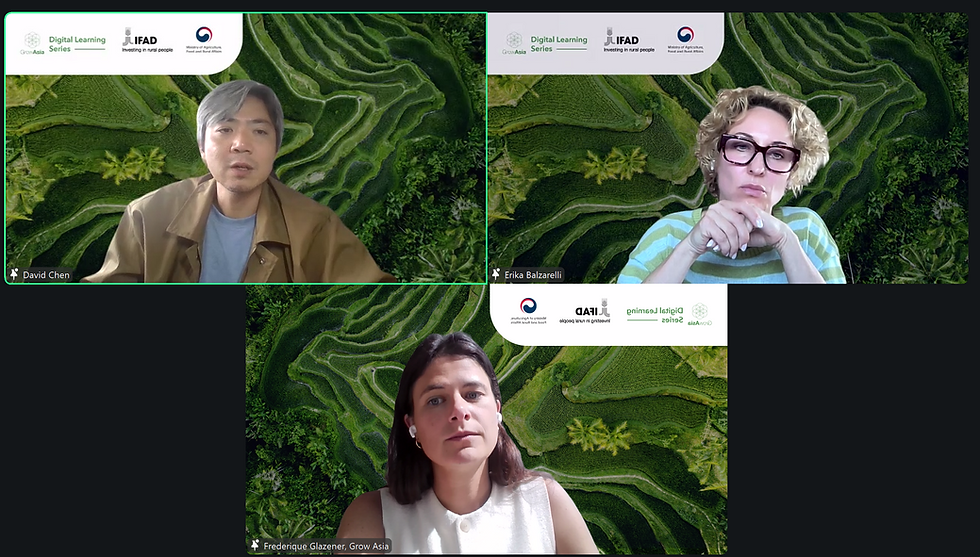
An important takeaway was the importance of commercial sustainability. Long-term adoption depends on business models that create value for all stakeholders and remain viable beyond donor-funded pilot phases.
Episode 3: Partnerships, Investment and Regional Coordination
The final episode featured Abdelkarim Sma, Lead Regional Economist at IFAD's Asia and Pacific Division, who provides strategic and analytical support for agricultural investments across more than 20 countries.
Karim framed the adoption challenge as a longstanding structural one that predates the digital agenda altogether: reaching smallholders has always been difficult because of their sheer number, their small scale, and their dispersion across hard-to-reach areas. The answer, he argued, lies in aggregation — bringing farmers together and anchoring them in rural institutions that connect them to inputs, markets, services, and information.
"Efficiency comes with scale and aggregation," Karim noted. "The challenge that we are seeing requires a solid foundational DPI, but also the institutional elements — the producer groups, the cooperatives, and the champions among them in ASEAN and Asia."

He welcomed the fact that digital transformation has lowered the entry cost for aggregation, making solutions more affordable than before, even as fragmentation and uneven digital public infrastructure across the region remain real obstacles. Drawing on lessons from Grow Asia's SEEDS project, he highlighted the concept of "digital arrowheads" – local service providers and community champions who are already embedded within farming communities. By building their capacity and supporting them with training and certification, digital solutions can be delivered through trusted networks that farmers already rely on.
This approach reflects a broader principle that resonated throughout the series: solutions are more likely to succeed when they are developed with farmers, rather than for farmers.
Looking Ahead
Across all three conversations, a consistent message emerged: while Digital Public Infrastructure provides an essential foundation, adoption depends on the people, partnerships, and business models that bring digital solutions to farmers.
Closing the adoption gap will require more than better technology. It will require stronger collaboration, trusted delivery networks, and aligned incentives across the agricultural ecosystem.
Through initiatives such as SEEDS and the GrowVentures Impact Fund, Grow Asia convenes governments, agribusinesses, financial institutions, technology providers, and farmer organizations to support the partnerships and ecosystem coordination needed to scale digital agriculture across ASEAN.
The full recordings of all three episodes are available on the Digital Learning Series platform.